Table Of Content

This article originally appeared on Understood.org (opens in a new window), a free online resource for parents of children with learning and attention issues. The chart below includes the three UDL principles adapted from CAST. It also gives you some questions to consider and lists some examples of the principles in action. You can print a one-page version of this chart to have on hand while planning a lesson, activity, or routine for your students. You don’t need specific tools or technologies to follow UDL’s principles either.
The UDL Guidelines
For example, you might give a visual representation of the content, an audio version, and a written transcript. When designing instruction and materials, it is essential first to assess the needs of your students. Teachers can do this through diagnostic assessments or by observing their students in their natural learning environment. For example, you can observe how students interact with the content and their strategies to understand it.
Universal Design for Learning - San Diego County Office of Education
Universal Design for Learning.
Posted: Mon, 10 Jul 2023 21:40:09 GMT [source]
Universal Design for Learning (UDL): A teacher’s guide
UDL brings that approach to the classroom or to workplace training. UDL helps build in more ways a diverse group of learners can access information and show what they know. Even if you’re not familiar with the term universal design, you’ve likely encountered it in your everyday life. Common examples include automatic doors and dictation tools on smartphones. Universal Design for Learning (UDL) is an approach to teaching and learning that gives all students equal opportunity to succeed. Effective UDL requires forethought and strategy in all areas of course planning and design.
UDL at a Glance
Offering content in different modalities, so students have the autonomy to choose their preferred method. Be deliberate in recruiting interest, maintaining interest, and offering autonomy over self-regulation during learning. There are different ways that learners can become engaged and participate in learning. For example, some learners are excited by new ideas and novelty, whereas others will find their anxiety increasing when faced with the unfamiliar.
Create a Climate of Inclusion
To get a deeper understanding of UDL, it also helps to see how it’s different from a traditional approach to education. Explore this chart that compares UDL and traditional education side by side (opens in a new window). By applying UDL principles, teachers can effectively instruct a diverse group of learners. They do this by building in flexibility in the ways learners can access information and in the ways students can demonstrate their knowledge.
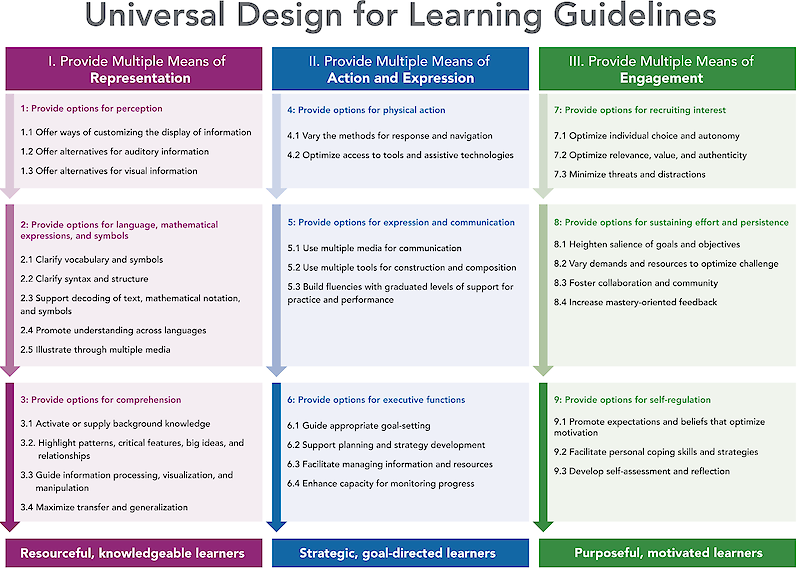
Moreover, UDL goes beyond providing equitable access to marginalized students to enhancing the learning experience for everyone. Mindful tactics such as sharing study resources and providing assignment options offer all students meaningful support and ownership in their learning. Universal Design for Learning (UDL) is a way of thinking about teaching and learning that helps give all students an equal opportunity to succeed. This approach offers flexibility in the ways students access material, engage with it and show what they know. Developing lesson plans this way helps all kids, but it may be especially helpful for kids with learning and attention issues.
I recently heard an adult tell me she would drop out of classes that required public speaking (presentation recordings) as it caused so much anxiety. Other individuals may struggle with organizational abilities (executive function disorders) and those that have language barriers, may need alternate ways of expressing themselves. Following these principles will inspire you to develop new ways to engage learners that you may not have considered in depth before. As a result, you will improve and increase the impact & accessibility of your course for all students.
Embracing the following four beliefs is the first step in designing learning experiences that serve all students. The UDL Guidelines are a tool used in the implementation of Universal Design for Learning. Find out how the UDL framework guides the design of instructional goals, assessments, methods, and materials that can be customized and adjusted to meet individual needs. You may, for example, have a student in your class with attention-deficit hyperactivity disorder.

This approach to teaching doesn’t specifically target kids with learning and attention issues. But it can be especially helpful for the 1 in 5 kids with these issues — including those who have not been formally diagnosed. The goal of UDL is to use a variety of teaching methods to remove any barriers to learning and give all students equal opportunities to succeed. It’s about building in flexibility that can be adjusted for every student’s strengths and needs. Introduced by educational researchers in the early 2000s, the Universal Design for Learning provides a framework for offering individualized support and inclusion to students. According to this educational framework, doing so is the best way to recognize a student’s strengths and challenges, and to limit any learning barriers at your school.
He is the former editor of the Journal of Learning Development in Higher Education and holds a PhD in Education from ACU. Teachers can present information in a variety of modalities, including print, digital formats, audio or visual forms. This fits with the UDL concept of adapting to the needs of students. If you were to browse through picture books and story books for young learners in the early part of the century, you would think that a majority of the world consisted of one race. This disparity between what is portrayed in books and what exists in the population also exists in the media.
Spark students’ interests and motivations by using exciting and relevant content and providing opportunities to participate in their learning actively. Universal Design for Learning principles also recommends providing multiple means of action and expression. Give students opportunities to interact with the content differently through movement, drama, art, and music. It also allows students to express themselves through writing, speaking, and signing. I am sure you have experienced the post-lunch afternoon slump that can destroy concentration. With the uptick in online learning requirements, now is the perfect time to familiarize yourself with how to make accessible courses that improve the learning experience for all participants.
Sometimes students didn’t have background knowledge, so we’d cover relevant topics and skills at the start. Other times, content wasn’t academically interesting or culturally relevant, so we found ways to tie it to their lives. I realized that many students needed clearer directions, checklists, and check-ins, so I created systems within our classroom to address this. One of the simplest ways to implement UDL is to offer multiple pathways to learning. This means providing students with different ways to access and understand the content.
But the end result allows students to access, learn, and interact in a variety of ways, addressing the needs and preferences of a wide range of learners. Sheryl Burgstahler and Rebecca Cory (2009) identify the following key principles of UDL. Universal Design for Learning (UDL) is a framework to improve and optimize teaching and learning for all people based on scientific insights into how humans learn.




No comments:
Post a Comment