Table Of Content
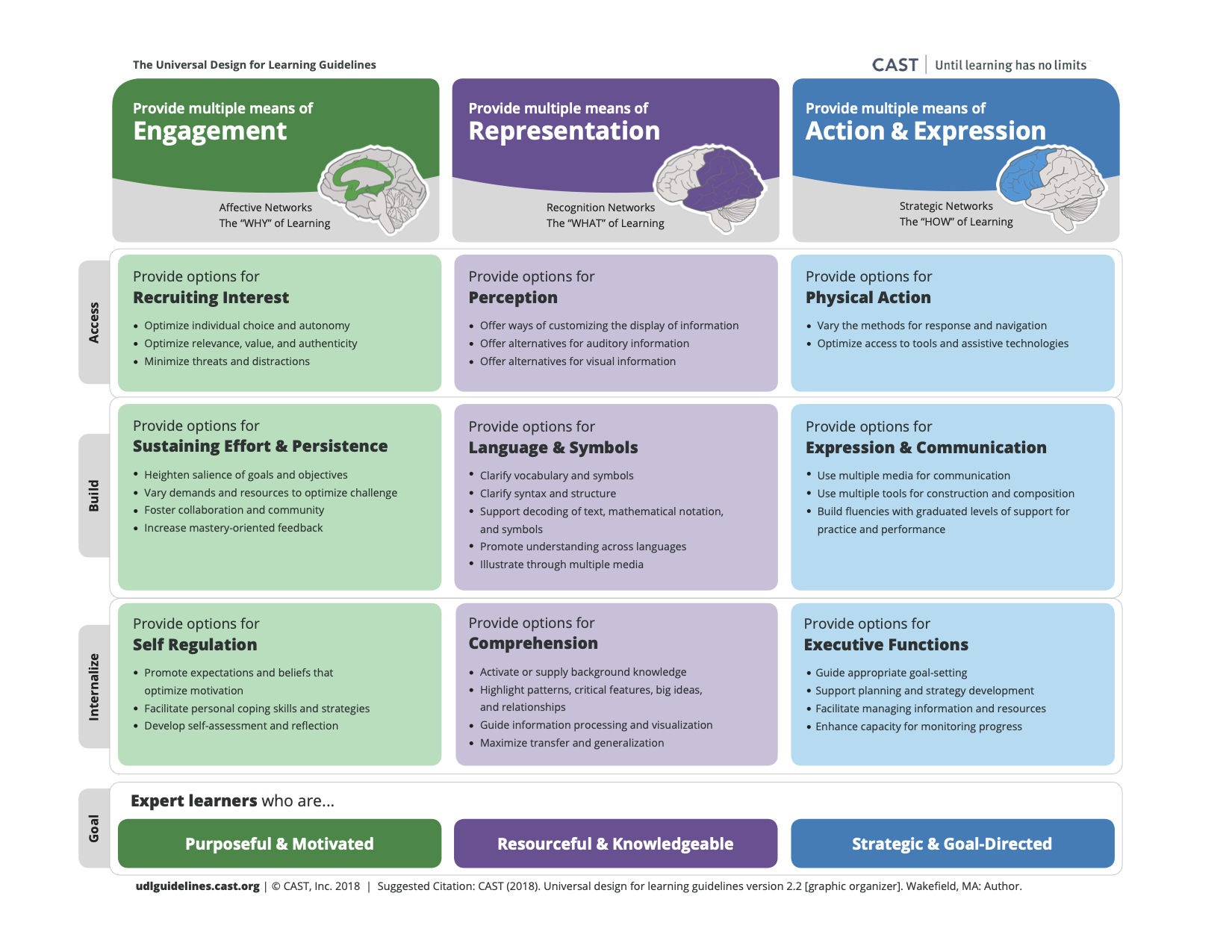
Learners need to have a clear picture in their mind of the progress that they are making in class. With regular, personal feedback for students, they’re able to see where they are, what progress they’ve made, and what they still need to accomplish. Alternatives should also be available for students when it comes to the range of motor action required to interact with the materials used in the classroom. For example, a math teacher could help students see the relationship between addition and multiplication, prompting them to draw on past experience to help them learn new concepts. Teachers should also guide students to build relationships between information they’ve already learned and what they’re currently learning.
Universal Design for Learning: Planning with All Students in Mind
When students are actively engaged in their learning, they are more likely to succeed. Learners have different ways of perceiving and comprehending when presented with information. Sensory perception, learning disabilities, cultural and social differences all impact how content is perceived. Architects first incorporated the concept to remove the barriers to building access and use for all. If you have ever hit a button with your elbow to automatically open a door to enter a building, while carrying two coffees, then you’ve experienced universal design. The basic premise of UDL is that each and every lesson has to take into account the incredible range of student characteristics that exist in the classroom.
George Lucas Educational Foundation
Then, they can discuss this goal with the class at the beginning of the lesson and write it out in a visible place for the whole class to see. Here are 13 different guidelines for how to use universal design for learning, along with examples that show what it looks like in practice. Follow these guidelines to make universal design for learning a part of your school. At Alludo, we believe that removing barriers to learning is one of the best ways to improve student learning and get to the best possible student outcomes. That’s why we have included courses and missions about Universal Design for Learning in our professional development catalog.
Representation Guidelines & Checkpoints

Instead, your students choose from the tools and resources you already have. The Ronald L. Mace Universal Design Institute (The Institute) is a non-profit organization based in North Carolina dedicated to promoting the concept and practice of accessible and universal design. What is engaging to one student may not be engaging to another, so it’s important for teachers who use UDL to assess each student and find ways to make lessons engaging and relevant. Special education is a term used to describe services and programming for students with disabilities. UDL is a philosophy that educators can use in addition to or instead of special education.
Watch a video of what UDL looks like in the fifth-grade classroom of Understood Teacher Fellow Eric Crouch. As educators, we've all experienced the challenge of evaluating student assignments filled with scattered ideas and jumbled thoughts, leaving us... Make study-time fun with 14,000+ games & activities, 450+ lesson plans, and more—free forever. Offer a glossary of terms as experts often get caught using jargon and acronyms that might be hard to follow for beginners. Studentsshould always cross-check any information on this site with their course teacher. UDL is based on research in cognitive science and neuroscience that has identified different areas of the brain that are involved with different types of learning.
Just as students engage with and respond to content differently, so too do they vary in their preferences for demonstrating learning. The 20th century brought remarkable social advancements in civil and human rights. An important part of this story is the Universal Design (UD) movement, which promoted the accessibility and usability of public environments, buildings, and products for all. UD is design that is equitable—in other words, usable, marketable, and appealing to people with a diverse range of abilities, characteristics, and preferences.
How you can help make CWRU more inclusive through digital accessibility - The Daily Case Western Reserve University
How you can help make CWRU more inclusive through digital accessibility.
Posted: Fri, 14 Jul 2023 07:00:00 GMT [source]
As disability studies scholar Jay Dolmage writes, UDL is "not a tailoring of the environment to marginal groups; it is a form of hope, a manner of trying" (2017). The history and tenets of UDL are intertwined with civil rights efforts for people with disabilities, so it is often discussed in conjunction with accessibility and accommodations. Accessibility is an important aspect of UDL, and they often go hand in hand.
An excellent place to start is the UDL Center’s website, which provides various resources, including an overview of UDL, how to get started, and case studies. You can also find helpful information from the National Center for Universal Design for Learning (NCUDL). If you use materials not explicitly designed for UDL, you may need to modify them to make them more accessible and inclusive. This could include changing the font size, adding alternate text, and increasing the contrast of colors. SplashLearn inspires lifelong curiosity with its game-based PreK-5 learning program loved by over 40 million children.
Universal Design for Learning (UDL): A teacher’s guide
When viewed in a positive light, this international flair can boost the atmosphere of a classroom and make it more inclusive. • Provide options for engaging with texts, such as text-to-speech, audiobooks, or partner reading. Watch your kids fall in love with math & reading through our scientifically designed curriculum. With so many options for where creators can build, post, and monetize content, we’ve decided to organize the top Coursera alternatives into one place.
Learners differ in the ways that they can navigate a learning environment and express what they know. Some may be able to express themselves well in written text but not speech, and vice versa. It should also be recognized that action and expression require a great deal of strategy, practice, and organization, and this is another area in which learners can differ. In reality, there is not one means of action and expression that will be optimal for all learners; providing options for action and expression is essential. Learners differ in the ways that they perceive and comprehend information that is presented to them.
The principles of UDL stipulate that teachers need to accommodate this characteristic rather than trying to make all children fit into one mode. For example, closed captioning is often used in noisy places like restaurants and airports to help everyone follow what’s being said on TV. Though it requires forethought and effort, proactively applying UDL will help you minimize barriers to learning and maximize success for all of your students. In a 2006 article on UDL in college classrooms, David Rose et al. describe the value of choice in student discussions. Consider setting up optional Carmen discussions or Teams channels based on various student needs. You might have a Review Forum for sharing questions, challenges and study tips, an Advanced Forum for expanding on material, and a Collaborative Forum for brainstorming and peer feedback.
Universal design can be found just about anywhere you look — both inside and outside your school. Curb cuts change sidewalks so that they’re accessible to the greatest range of users, including people who use wheelchairs and those pushing strollers. Closed captions make television accessible to people who are deaf or who have hearing loss, as well as people at the gym or spouses who can’t agree whether or not to keep the TV on at night.
Others may simply grasp information quicker or more efficiently through visual or auditory means rather than printed text. Also learning, and transfer of learning, occurs when multiple representations are used, because they allow students to make connections within, as well as between, concepts. In short, there is not one means of representation that will be optimal for all learners; providing options for representation is essential. Other examples of UDL in the classroom include letting students complete an assignment by making a video or a comic strip.



No comments:
Post a Comment